Tenderly now fully supports MegaETH, the blockchain built for real-time performance. We wanted to make sure our tools were properly calibrated for a chain running at this speed before shipping, and now they are. Developers building on MegaETH can access Tenderly's complete infrastructure stack: Virtual TestNets, production-grade Node RPC, transaction debugging, simulation, and monitoring, all fine-tuned for MegaETH's real-time performance and the most demanding on-chain applications.
What is MegaETH?
Some chains are fast. MegaETH is something different.
Launched on mainnet on February 9, 2026, MegaETH is dubbed the first "real-time blockchain", and the description holds up. It targets block times of 10 milliseconds and a theoretical throughput of 100,000 transactions per second. During its pre-launch stress test, the network processed over 10.7 billion transactions in a single week, a volume that surpassed Ethereum's entire decade-long transaction history.
That stress test also ran live Web3 applications (games, DeFi protocols, consumer apps), all operating without congestion or degraded performance. Real applications, real load, real-time results.
The project is developed by MegaLabs, which raised a $20 million seed round led by Dragonfly Capital, and is backed by Ethereum co-founders Vitalik Buterin and Joe Lubin. Its $50 million token sale in October 2025 was roughly 20x oversubscribed, with over $1.39 billion in bid contributions pouring in before the hard cap was reached.
How MegaETH actually works?
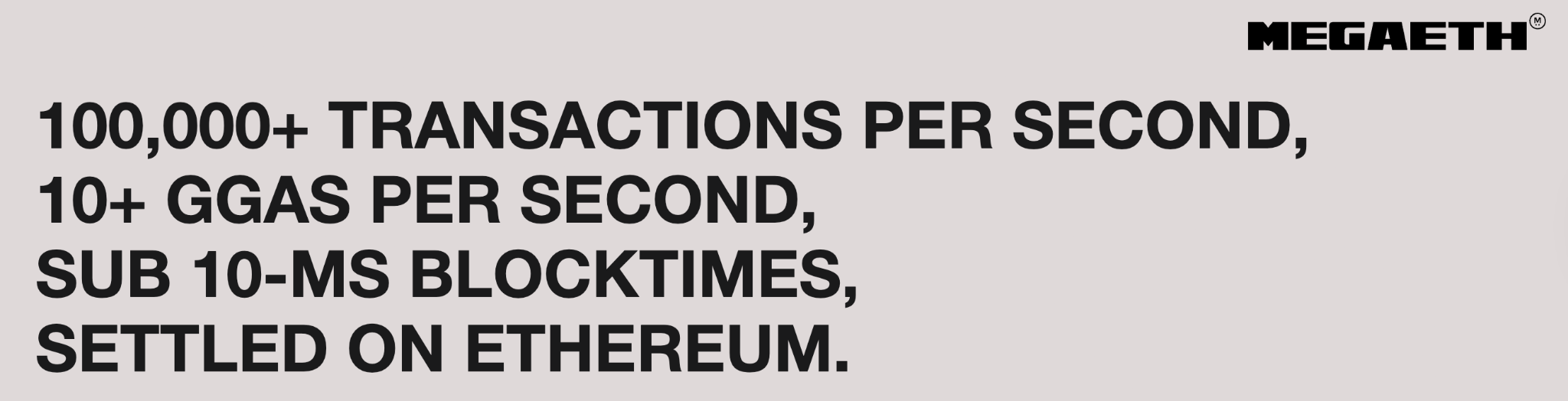
The speed isn't magic. It comes from rethinking how nodes are structured and how execution happens.
MegaETH uses a heterogeneous node architecture. Rather than having every node do everything, it separates roles: Sequencers handle transaction ordering and execution, Replica Nodes validate blocks via cryptographic proofs without re-executing them, and Full Nodes re-execute all transactions for independent verification. This specialisation is what unlocks the throughput numbers.
Execution is handled by a Streaming EVM, a continuous transaction processing engine that moves away from the traditional batch-based block model. Transactions don't wait for a block boundary; they process as they arrive. The result is sub-second finality, something that was simply off the table for most EVM chains.
MegaETH also introduced SALT (Small Authentication Large Trie), a state architecture designed to eliminate disk I/O bottlenecks by keeping the full authentication structure in RAM. It's the kind of infrastructure work that doesn't make headlines but is what actually makes 100k TPS feel plausible rather than just theoretical.
Despite all of this, the network is fully EVM-compatible. Existing Ethereum smart contracts, Hardhat, and very much all Tenderly infrastructure and developer tooling works without modification.
Why this integration matters?
MegaETH was explicitly designed for applications that demand near-instant transaction speeds: high-frequency trading platforms, real-time gaming, AI agents, and consumer finance apps. These use cases don't just need a fast chain. They need an infrastructure layer that can keep up with them.
That's where Tenderly comes in.
When transactions are moving at millisecond speed and your application is handling hundreds of interactions per second, the ability to simulate, debug, and monitor in real time isn't a nice-to-have. Tenderly's Node infrastructure provides the reliable RPC foundation these applications needs, while Virtual TestNets let teams iterate in isolated environments without touching mainnet state. The debugger gives you line-by-line visibility into what happened inside a transaction, invaluable when failure analysis needs to be fast and precise.
The MegaETH mainnet launched with Rabbithole, a natural-language discovery portal that lets users navigate the ecosystem and interact with live applications. The initial wave of apps spans trading, yield, DeFi, gaming, and social, with more to come. This is a network designed for builders who want to move without waiting, and Tenderly's blockchain operations platform is there from day one.
MegaETH launches!
Since the mainnet launched in February, MegaETH has moved quickly. A few things worth knowing before you start building:
Chainlink was live at launch, giving the ecosystem immediate access to Aave, GMX, and nearly $14B in flagship DeFi assets, including Lido's wstETH and Lombard's BTC.b and LBTC. Composability is already there from day one.
In April, 10 MegaMafia-incubated applications each crossed 100,000 verified transactions over a 30-day window, triggering the MEGA TGE. These aren't deployed contracts sitting idle. Cap, Kumbaya, Ubitel, Showdown, Stomp, and others are running real user activity, and that milestone triggered a KPI-gated token release - one of the more credible launch structures the space has seen.
TVL reached $490 million at TGE, placing MegaETH in the top 15 chains globally in DeFi rankings.
What's available today?
With this integration, Tenderly fully supports the MegaETH mainnet. Developers can rely on:
- Node RPCs - Connect to MegaETH via Tenderly's Node RPCs with guaranteed uptime and no rate-limit surprises. Whether you're running a high-frequency trading bot or a consumer app expecting sudden traffic spikes, the infrastructure holds up when it matters.
- Virtual TestNets - Fork the MegaETH mainnet in its state to build and test against real mainnet conditions in private, isolated settings. You can:
- Impersonate any wallet or contract address
- Mint test tokens without needing a faucet
- Share the environment across your whole team for collaborative testing
- Reset state at any point and start fresh without side effects
- Debugger - Debug any MegaETH transaction with full execution traces, state diffs, and event logs. Every function call, every state change, every revert - visible and navigable. On a chain moving at millisecond speed, being able to pinpoint exactly what went wrong without guesswork is what keeps development cycles short.
- Simulations - Simulate transactions before sending them on-chain to validate behavior and catch issues before they cost real gas. Test edge cases, model different chain states, and run what-if scenarios against live MegaETH state. Especially useful for DeFi protocols and anything where transaction ordering matters.
- Alerting and Monitoring - Monitor smart contracts with real-time alerts and dashboards. Set up custom triggers on any on-chain event, wallet activity, or contract state change. Given MegaETH's throughput, having visibility across everything happening on-chain isn't optional - it's how you stay on top of a fast-moving ecosystem.
Ten live apps with verified real usage. Nearly half a billion in TVL. Chainlink, Aave, and GMX are accessible from day one. If you're building anything that needs real-time execution on Ethereum, MegaETH is where the action is. Tenderly is ready.
BUILD THE WORLD IN REAL TIME.
…with Tenderly full-stack infrastructure.