We're excited to announce that Tenderly is now supporting peaq, the Layer-1 blockchain powering the Machine Economy, including DePIN, DePAI, and Machine RWAs. In an important milestone for both platforms, peaq becomes the first network to integrate Tenderly's newly-designed public blockchain explorer, marking a transformative chapter in how developers interact with DePIN infrastructure and the broader Machine Economy.
This collaboration brings our advanced public explorer and essential developer tooling to the peaq ecosystem, providing a transparent, developer-friendly way to understand, debug, and interact with onchain activity. It delivers a feature-rich public explorer with industry-leading developer tooling and Etherscan-compatible APIs to serve both developers and the broader community.
"Tenderly provides peaq with a robust and reliable tool stack that empowers builders to deploy and scale faster and gives the community an eagle's eye view of the Machine Economy's backbone. This integration amps up the transparency across the entire ecosystem and makes building on peaq even easier—another step reaffirming its place as the ultimate home for any real-world applications." - Leonard Dorlöchter, co-founder of peaq.
The rise of the Machine Economy: understanding peaq’s vision
peaq is designed for the emerging Machine Economy, where machines, vehicles, devices, and infrastructure can own wallets, interact autonomously, and exchange value. By enabling developers to build dapps for physical infrastructure — from mobility networks to energy grids — peaq is unlocking new forms of economic activity, decentralization, and data monetization.
peaq’s vision also puts community empowerment at its core, enabling people to crowdfund and crowdsource real-world infrastructure, from sensor networks and electric vehicle chargers to decentralized cloud services and AI platforms. Its push for tokenizing value-generating machines aims to empower anyone to co-own and benefit from automation, earning from tokenized robo-cafes, unmanned shops, and other similar projects.
What distinguishes peaq is its singular focus on real-world applications. The network handles the unique challenges of coordinating millions of physical devices, processing high-frequency machine transactions, and managing complex data flows that characterize real-world infrastructure networks. As peaq's ecosystem grows, so does the need for fast, reliable, and developer-friendly tooling that enables builders and users to inspect every detail of the network in real time.
Technical architecture: building for scale and interoperability
peaq's technical architecture represents a sophisticated approach to blockchain design, balancing performance, flexibility, and developer accessibility. Built on the Substrate framework powering Polkadot, peaq inherits a robust foundation while adding innovations tailored for DePIN applications.
Consensus mechanism
The network uses Nominated Proof of Stake (NPoS), a consensus model inherited from its Substrate foundation. In this system, collators are responsible for producing new blocks and maintaining the network state, while validators verify and finalize those blocks to secure the chain. This separation of responsibilities ensures high performance and scalability without compromising security — enabling rapid block production while maintaining strong finality guarantees.
Scalability roadmap
Current capabilities and future vision:
- Current: 10,000 transactions per second (TPS) in optimal network conditions
- Transaction fees: As low as $0.00025
- Future target: 100,000 TPS through:
- Parallelized block production
- Asynchronous backing
- Agile Core Time resource allocation
- Elastic Scaling technologies
This throughput level is essential for supporting billions of devices expected to participate in the machine economy over the coming decades.
Developer flexibility
The network prioritizes developer accessibility through:
- Full EVM compatibility: Deploy Solidity smart contracts with minimal modifications
- Rust-based smart contracts: WebAssembly (WASM) support for performance optimization
- Dual programming approach: Developers from different backgrounds can contribute without learning entirely new toolsets
Modular DePIN functions: pre-built infra for machine networks
Perhaps peaq's most innovative contribution to the DePIN ecosystem is its suite of modular DePIN functions – ready-to-use modules that dramatically accelerate the development of machine-centric applications. These functions, accessible through the peaq SDK in JavaScript or Python, can be deployed with minimal code:
- The peaq ID system provides self-sovereign machine identities, enabling hardware devices like vehicles, robots, and sensors to establish verifiable identities on the blockchain.
- peaq access implements sophisticated role-based access control (RBAC) that goes beyond traditional permission systems. In a DePIN context, this means a smart energy grid can automatically grant different levels of access based on verified roles and current network conditions.
- peaq pay facilitates seamless machine-to-machine and machine-to-human transactions by implementing advanced payment verification protocols.
- peaq verify provides a multi-tiered data verification framework crucial for maintaining data integrity in decentralized networks.
- The platform also incorporates Universal Machine Time (UMT), ensuring nanosecond-accurate time synchronization across all connected devices. This might seem like a minor detail, but precise timing is crucial for coordinating complex machine interactions.
- peaq store provides a decentralized key-value storage system optimized for machine-generated data, handling the unique patterns and volumes characteristic of IoT applications.
Interoperability: bridging the fragmented Web3 landscape
peaq prioritizes interoperability as a core design principle, ensuring DePINs can seamlessly interact across the broader blockchain ecosystem.
Multichain connectivity
- Polkadot integration: Native Cross-Chain Messaging (XCM) enables communication with any parachain, allowing DePINs to leverage specialized chains for specific functions
- EVM compatibility: Seamless interaction with the Ethereum ecosystem, Layer-2 solutions, and sidechains
- Bridging and routing: Stargate and Squid connect peaq with dozens of other blockchains
Enterprise partnerships
Beyond blockchain interoperability, peaq has forged strategic partnerships:
- Bosch-led moveID consortium: Including Airbus and Continental for decentralized mobility standards
- Mastercard collaboration: Exploring traditional payment rail integration with machine economy applications
These partnerships bridge Web3 innovation with real-world enterprise adoption, while the ecosystem currently hosts over 50 DePIN projects across 22 industries with 6+ million connected devices, including successful projects like Silencio, MapMetrics, Farmsent, and Teneo Protocol.
Introducing Tenderly's comprehensive public explorer for peaq
Tenderly's integration with peaq represents a critical infrastructure upgrade that will accelerate the ecosystem's development. As peaq becomes the first network to leverage our newly redesigned public blockchain explorer, we're providing developers with professional-grade tools that also cater to the unique requirements of DePIN applications.
This integration represents a carefully focused approach to blockchain infrastructure support. While Tenderly offers an extensive range of services across various networks, including advanced features such as node infrastructure, security simulations, Virtual TestNets, and alerting systems, our collaboration with peaq centers specifically on delivering essential explorer and developer tooling capabilities. This focused approach ensures that peaq developers receive exactly the tools they need for their current development phase, with the flexibility to expand capabilities as the ecosystem grows.
Complete visibility into DePIN operations
The integration delivers Tenderly's new public explorer — a modern, intuitive, and deeply technical window into the peaq network activity. Our explorer goes beyond basic blockchain data display, offering advanced development tooling directly from the block and transaction view, with options to simulate and debug transactions readily available.
1. Comprehensive onchain visibility
Explore peaq mainnet and peaq agung testnet with complete transparency into network activity, searchable by transaction hash, wallet address, block number, and contract names. Here’s the breakdown of essential features.
Explorer homepage
- Real-time network status with block height or the last finalized block, and general network performance, including transaction throughput
- Key information such as average block time, average gas price, as well as the latest blocks and transactions
peaq explorer powered by Tenderly
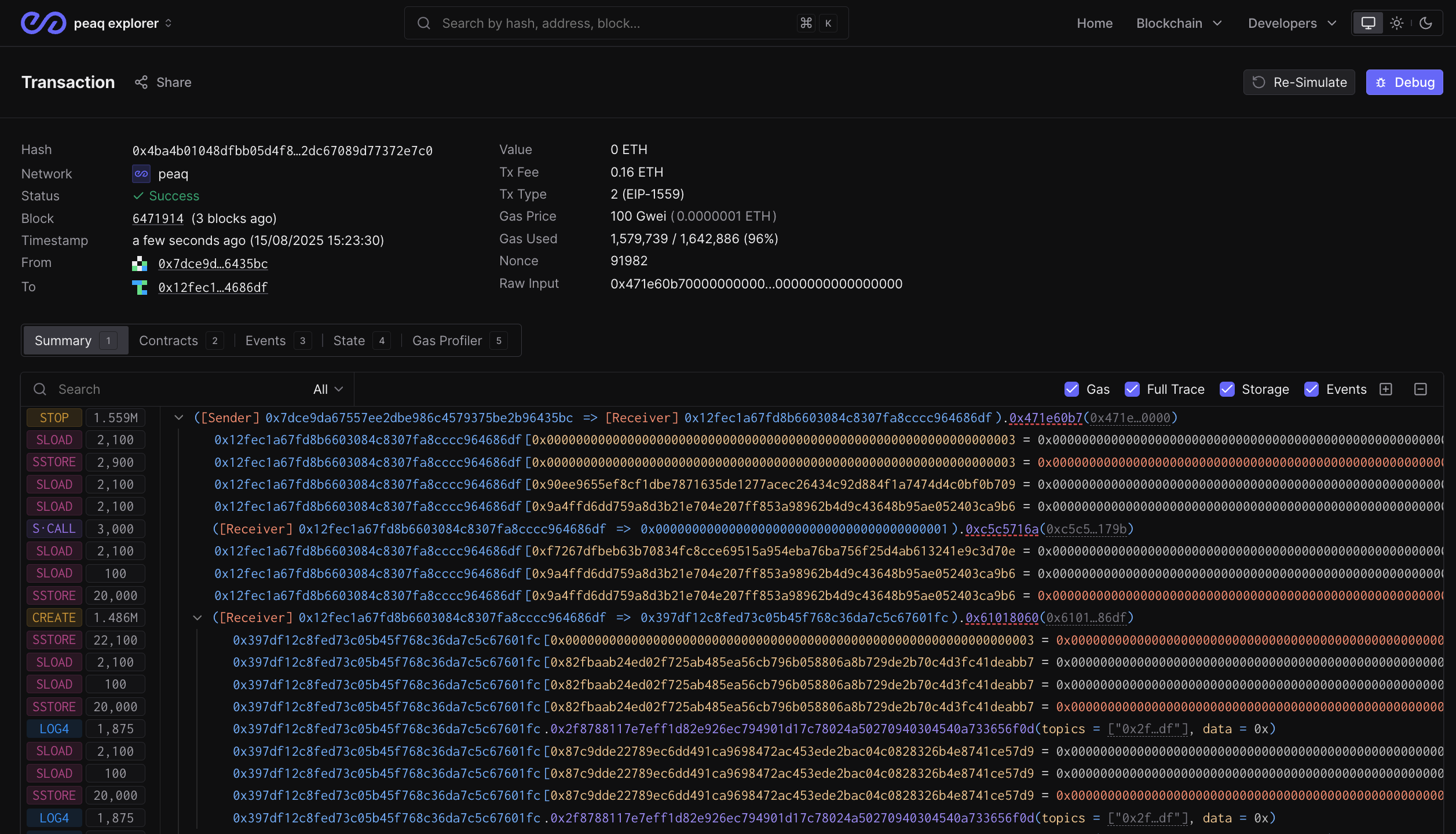
Transaction overview page
- All the essential transaction information, including hash, status, block number, timestamp, and ETH value, transaction fee and type, gas price and gas used, nonce and raw input
- Detailed execution traces, with opcode-level inspection available for verified smart contracts
- Decoded call data with human-readable function names and parameters
- Smart contracts involved and events emitted
- Gas usage analysis with cost breakdown
- State changes visualization showing before/after values for affected storage slots
- Options to simulate and debug directly from the transaction preview
Block page
- Full block details, including block height, timestamp, hash, parent hash, and gas used and limit
- Block rewards distribution showing validator rewards and transaction fees
- Complete list of included transactions with essential information
- Option to simulate any transaction from that specific block’s state.
Wallet Page
- Complete transaction history with basic filtering between token and NFT transfers
- Token holdings, including peaq balance and dollar value
- NFT holdings across collections
Contract Page
- Complete history of transactions involved with filtering between token and NFT transfers
- Verified source code with syntax highlighting and code navigation
- Interactive ABI interface for reading contract state and executing functions
- Contract creation details and deployment transaction
- Option to simulate or debug verified smart contracts directly from the contract view
2. Developer-centric debugging & simulation
Tenderly's advanced debugging and simulation tools are integrated directly into the peaq explorer, providing unprecedented visibility into smart contract execution and transaction behavior.
To unlock the full power of Tenderly's debugging and simulation capabilities, smart contract verification is an essential first step. When developers verify their contracts on the explorer, they enable source code-level debugging, allowing the debugger to map execution directly to their Solidity code. This verification process uploads the contract source code and metadata, creating a transparent and auditable record while enabling advanced development features.
Tenderly Debugger and Simulations in peaq explorer
Tenderly Debugger
Our Debugger is specifically optimized for DePIN development challenges:
Once contracts are verified, Tenderly Debugger provides comprehensive transaction analysis capabilities:
- Step-by-step execution: Navigate through every opcode with a visual execution trace showing gas consumption at each step. The debugger displays the EVM's low-level operations alongside their gas costs, helping developers identify optimization opportunities and understand execution flow.
- Stack & memory inspection: View the complete EVM stack, memory, and storage at any point during execution. This granular visibility allows developers to track how data moves through the execution environment and identify unexpected state changes.
- Solidity source mapping: With verified contracts, see exactly which line of Solidity code is executing with variable values displayed in context. The debugger highlights the current execution line and shows local variable values, making it easy to follow complex logic paths.
- Event & log analysis: Track all events emitted during transaction execution with automatically decoded parameters. The debugger recognizes standard event signatures and presents them in human-readable format, essential for understanding contract behavior and debugging event-driven systems.
- State diff visualization: Compare the contract state before and after execution to understand exact changes. The visual diff shows which storage slots were modified, their previous values, and new values, making it simple to verify that transactions produce expected state changes.
- Call trace navigation: Explore complex internal transactions and cross-contract calls with an interactive tree view. The debugger visualizes the entire call hierarchy, showing how contracts interact, which functions are called, and how value and data flow between them.
Transaction Simulator
Test and validate transactions before sending them to the network:
- Pre-execution testing: Simulate any transaction to predict its outcome without spending gas
- State overrides: Modify contract state, account balances, or storage to test edge cases
- Batch simulation: Test multiple transactions in sequence to understand complex interactions
- Gas estimation: Get accurate gas estimates with breakdown by operation type
- Failure analysis: Understand why transactions would revert with detailed error messages
3. Etherscan-compatible APIs for seamless integration
Our API suite ensures complete compatibility with existing tools:
Core Etherscan APIs
- Get block and uncle rewards by block number: Retrieve block rewards and uncle rewards for a specific block number.
- ERC-721 Transfer Events by Address: Track NFT transfer events associated with a specific address on the network.
- ERC-1155 Transfer Events by Address: Monitor multi-token standard transfer events for a given address.
Building the decentralized future together
This integration marks the beginning of our journey with peaq and the DePIN ecosystem. As the network scales toward 100,000 TPS and billions of connected devices, Tenderly will continuously enhance our tools to meet the growing Web3 ecosystem needs.
The partnership between Tenderly and peaq represents more than technical integration. It's about lowering barriers to entry and accelerating innovation in blockchain's most impactful use cases. Our explorer and debugging tools ensure developers can build with confidence, users can verify network operations, and enterprises can trust the infrastructure supporting their applications.
Projects on peaq are already revolutionizing industries, from MapMetrics' decentralized navigation with 65,000+ drivers to Farmsent connecting 160,000+ farmers. With Tenderly's tools, these projects can build more efficiently, debug more effectively, and scale with confidence.
By being the first adopter of Tenderly's new public explorer, peaq sets the tone for how modern blockchain explorers should look and feel — powerful enough for developers, yet intuitive for everyday users.
Explore peaq today
The new public explorer is live and ready to use. Whether you're building the next DePIN application or simply tracking your onchain activity, you can now access the full power of Tenderly's explorer on peaq.
🔗 Start exploring:
- peaq: peaqscan.xyz
- peaq agung: https://testnet.peaqscan.xyz/
🔗 Additional peaq links:
- Website: https://www.peaq.xyz/
- Portal: portal.peaq.xyz/portal/dashboard
- Docs: https://docs.peaq.xyz/