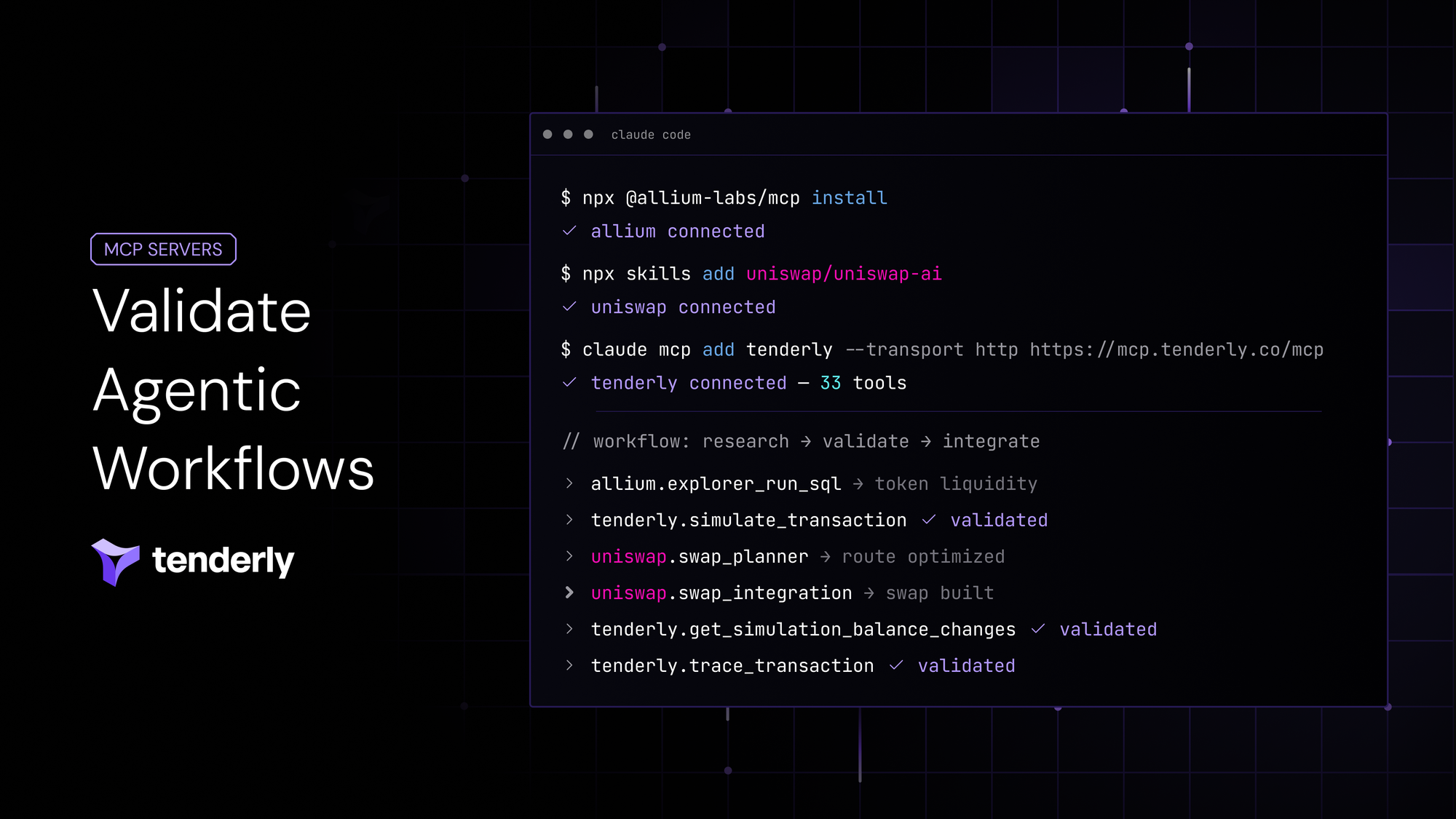
MCP servers are enabling AI agents to interact with onchain systems, becoming an essential component of the Web3 stack. Teams like Uniswap, Allium, and others shipped AI tools and MCP servers to replace manual workflows and custom integrations. But the real power lies in their composability: multiple MCP servers can work together to unlock powerful, autonomous workflows, using one agent to query onchain data, another to integrate swaps, and a third to analyze what happened onchain.
However, as these workflows become more autonomous, a critical step emerges: validation. While AI agents can independently analyze data and execute actions, they still cannot evaluate nuances in execution, validate the steps, and ensure correctness. Yet, in the context of irreversible transactions, nuances matter, and a validation step is essential for uncovering them.
That's where the Tenderly MCP Server comes in, enabling teams to build and automate agentic workflows while ensuring safe, confident execution every step of the way. You can use it to simulate, debug, and test onchain activity independently or with other servers.
Let’s see what you can do with the Tenderly MCP Server and explore some interesting examples of how to use it with Uniswap's AI tools and Allium's MCP Server.
Agents hallucinate. What can you do about it?
MCP servers enable AI agents to operate autonomously, so you can automate manual, repetitive tasks and focus on building your core product. However, they still hallucinate, extract data and context from unverified or third-party sources, and can add their own interpretations on top of your requests.
In the blockchain world, an AI agent hallucinating can not only cost you your time, but also your or users’ funds. You can easily approve a transaction with incorrect parameters, resulting in unwanted consequences. Ultimately, you spend more time checking every step or trying to correct your AI agents than you would have doing the task yourself.
So, ongoing validation is essential to ensure your agentic workflows work as expected and without surprises. For this reason, simulation technology available through the Tenderly MCP Server becomes a critical part of AI automations, letting you preview the results of AI-enabled actions and minimize risks before they reach production.
Validate agentic workflows with the Tenderly MCP Server
The Tenderly MCP Server empowers agentic workflows by bringing 33 essential tools for simulating, tracing, debugging, and testing on-chain activity. By connecting to the server, you can access some of Tenderly’s core functionalities directly from Claude Code or any other MCP-compatible client.
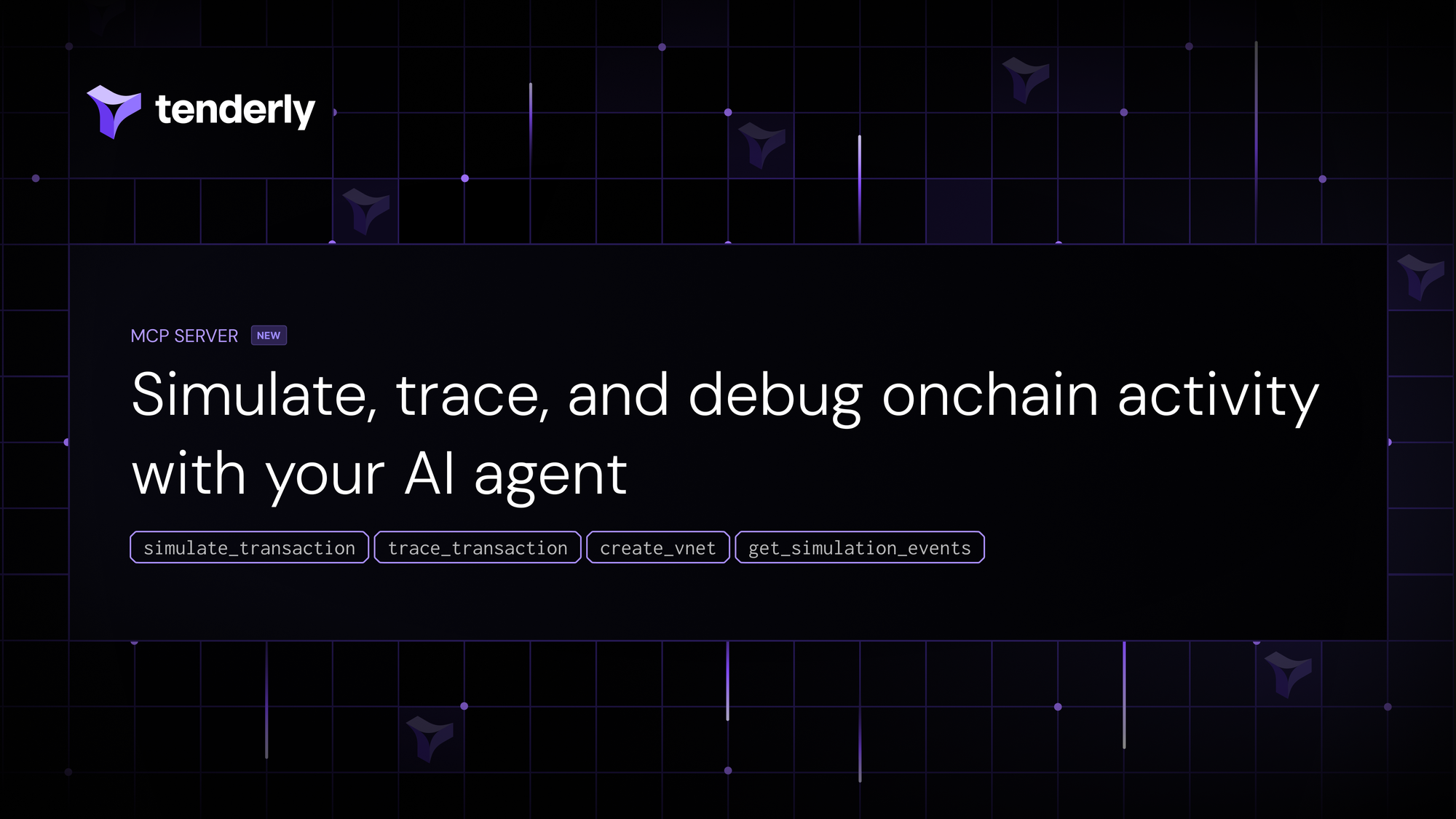
Backed by Tenderly’s simulation technology and granular debugging capabilities, the MCP server enables pre-deployment validation and production troubleshooting. You can use it to validate transactions before sending them onchain, trace their onchain execution, and surface the exact causes behind failures in customer-facing flows.
You asked, we listened.
— Tenderly (@TenderlyApp) March 23, 2026
The Tenderly MCP Server is ready to power your workflows. 🤖
Run 33 Tenderly tools directly from Claude Code or other MCP-compatible clients.
Discover some interesting use cases this week and speed up your workflows. 🧵 pic.twitter.com/XsRR5y3l78
With the Tenderly MCP Server, you can enable different validation, testing, and troubleshooting use cases, including:
- Pre-deployment validation with simulations: Simulate transactions and multi-step contract interactions before approving them to check the outcomes and avoid unexpected failures. The server simulates a transaction against onchain state, providing a preview of the expected execution along with balance changes, asset transfers, and emitted events.
- Excellent customer support with faster issue resolution: Run the MCP Server to quickly inspect and debug users’ failed transactions, with the exact, human-readable explanation behind the failure. This way, you can speed up issue resolution by enabling your customer support team to debug transactions and simulate a fix even without extensive technical knowledge.
- Step-by-step transaction tracing and analysis: Gain a deeper understanding and full context around transaction execution. Instead of reconstructing the transaction flow yourself, run the MCP server and get the execution overview with a clear explanation of what happened within a transaction.
This way, your AI agents can move fast in automated workflows, with the Tenderly MCP Server giving you confidence through continuous validation and quick troubleshooting.
Get started by running a simple command:
claude mcp add tenderly --transport http https://mcp.tenderly.co/mcp
Workflow examples: how to use Tenderly MCP with Uniswap and Allium
The power of MCP servers lies in their composability. For instance, you can use the Tenderly MCP server with the servers from Uniswap and Allium. While the Uniswap MCP enables you to build on top of the protocol through agentic workflows, the Allium MCP gives your agent access to onchain data without unnecessary complexity.
Let's see how to use them together.
How to use the Tenderly MCP with Uniswap’s AI tools
Uniswap's AI toolkit gives agents structured access to the protocol through open-source skills for swap integration, liquidity planning, swap planning, and other protocol interactions. Using the AI tools, agents can integrate swaps, plan liquidity positions, and build on Uniswap V4.
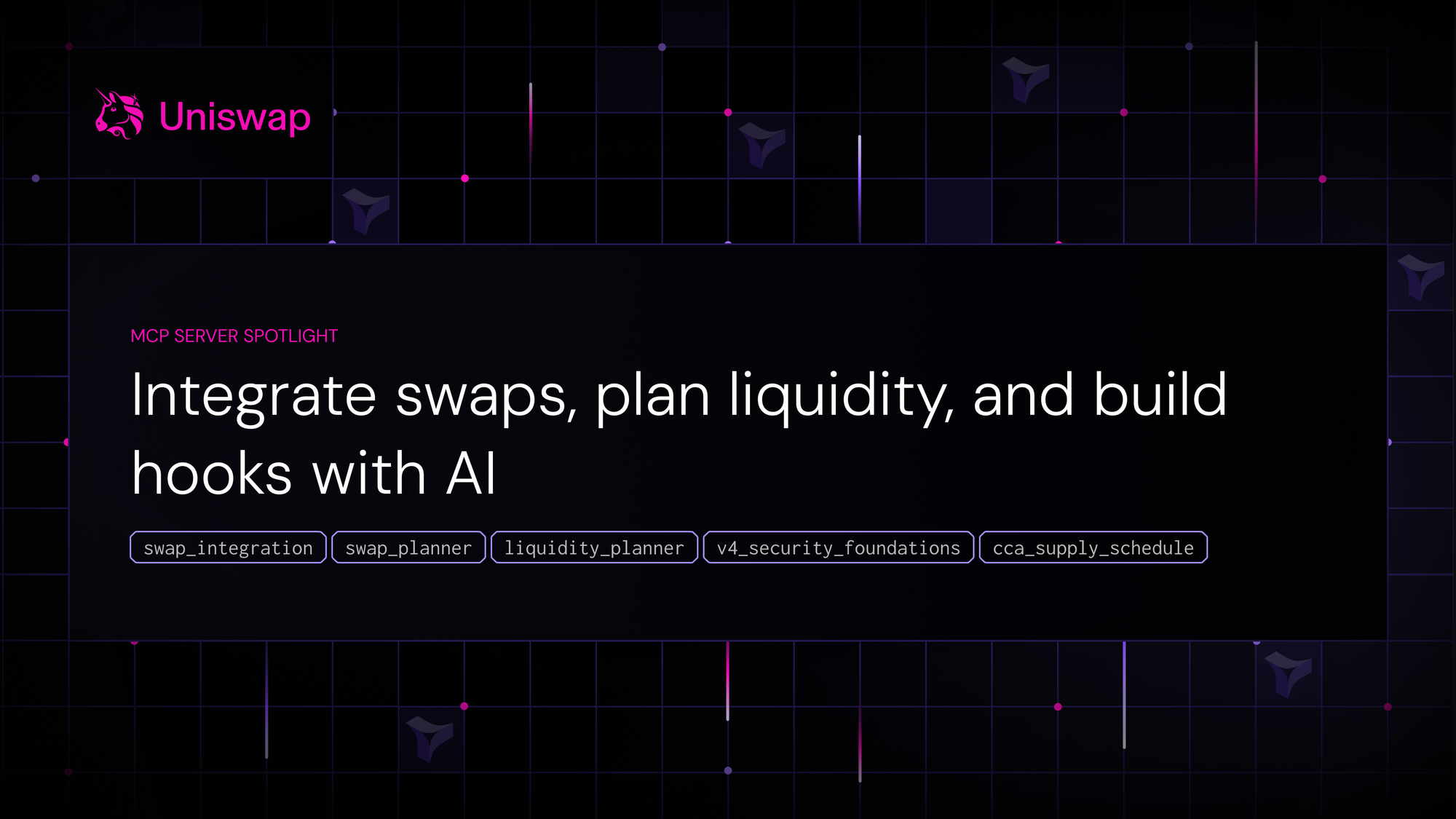
As one of the key protocols powering blockchain applications, Uniswap has become the underlying infrastructure for onchain finance. The Uniswap AI tools enable you to integrate and interact with the protocol faster, running automated workflows on top of the protocol.
Building on top of @Uniswap? 🦄
— Tenderly (@TenderlyApp) March 25, 2026
Uniswap's AI tools give you the skills for faster and easier protocol integration and interaction.
Build, integrate, and plan swaps through agentic workflows 🧵 pic.twitter.com/vXRgyZSlTb
Using Tenderly with Uniswap
Validation is a critical step in any workflow that relies on Uniswap's AI tools for swap integration. For instance, when an agent plans a trade through Uniswap's swap-integration skill, the parameters are set: token pair, amount, slippage, and route. But the actual outcome is uncertain until the transaction hits the chain.
The Tenderly MCP Server removes that uncertainty. The agent validates the transaction by running simulate_transaction and gets the expected result, including token transfers, balance changes, and gas costs.
For teams running automated DeFi operations, the validation step applies to every Uniswap interaction, including liquidity provisioning, pool configuration, and governance actions. So, for any Uniswap-related workflow preceding onchain execution, Tenderly MCP Server acts as a validation check.
How to use the Tenderly MCP with Allium’s MCP
Allium's MCP Server brings blockchain data from 150+ chains directly to your agent, providing comprehensive context while removing onchain complexity. Agents can run SQL queries against Allium's schemas, execute saved Explorer queries, look up token prices, check wallet balances, and pull transaction histories without requiring REST endpoints or custom pipelines.
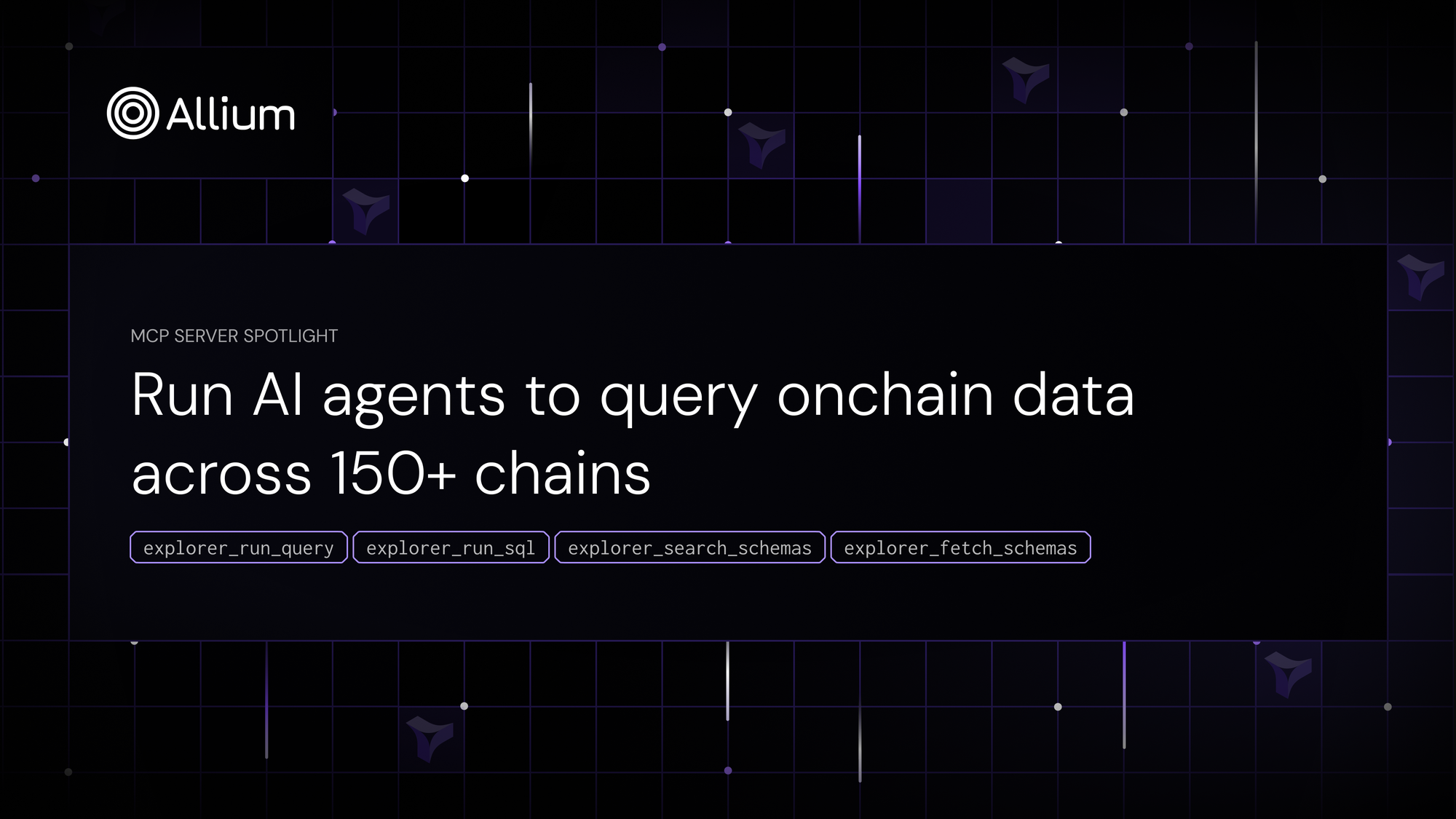
The Allium MCP Server acts as a data layer of the agentic Web3 stack, bringing rich insights that you can use to power the rest of your workflow.
Empower your AI agents with @AlliumLabs APIs to query data on 150+ chains.
— Tenderly (@TenderlyApp) March 24, 2026
Let your agents explore production-grade blockchain data without unnecessary complexity and noise.
Explore the Allium MCP Server 🧵 pic.twitter.com/66EIf3rXk7
Using Tenderly with Allium
Querying data and gathering insights is just the first step. Once you analyze onchain activity, you can use it to inform your subsequent actions. However, before acting on those specific insights, your AI agent can call the Tenderly MCP Server and execute simulate_transaction to validate a specific interaction. The simulation can catch the hidden nuances behind the data, including unexpected transfers, approval logic, or reverts.
Plus, the combined use of these two servers can even enable customer support and operations teams through easier onchain debugging. When a user reports a failed transaction, the support agent can use Allium and Tenderly to pull the onchain context, replay the transaction, and surface the revert reason in a human-readable format. The Tenderly MCP can even simulate to check what inputs would have resulted in a successful transaction.
The power of composability: how to run a unified workflow
Here’s an example workflow of using the three MCP servers as a single, composable stack, building on top of the other to extend individual functionalities and validate execution throughout the process.
- Research onchain data with Allium: The agent queries Allium's MCP server to pull onchain data for a token, such as its liquidity depth, transaction volume, holder distribution, and contract interactions across chains. It runs SQL against enriched schemas to verify the fundamentals.
- Validate the contract with Tenderly: Before further using the data, the agent relies on Tenderly to inspect the token contract, pulling the ABI and checking token standards. It calls
simulate_transactionwith a small test amount to confirm the token behaves as expected (e.g., without hidden approval logic). - Plan and simulate a swap with Uniswap and Tenderly. The agent uses Uniswap's swap-integration skill to plan the optimal route. Before executing, it validates the transaction using the Tenderly MCP Server to preview the outcome. It can surface the expected balance changes or gas usage, surfacing any unusual output. If a simulation shows an unusual behavior, the agent can stop the flow.
- Execute the swap once validated. If the Tenderly simulation confirms the expected outcome, the swap can be submitted onchain with confidence.
- Post-execution tracing with Tenderly. After execution, the agent calls
trace_transactionto verify the on-chain result matches the simulation. If there's a discrepancy, it flags it for additional review and troubleshooting.
Instead of going from research to execution with no validation in between, every critical step goes through a simulation check using the Tenderly MCP Server to ensure proper execution without unintended consequences.
Build faster with AI, validate with Tenderly
Enabling different types of blockchain interaction, MCP servers can run onchain queries, perform automated analysis, and speed up integrations. As they become more autonomous and automated, validating their execution and flow is business-critical.
The Tenderly MCP Server provides a validation layer that brings visibility, control, and confidence every step of the way. Build and automate agentic workflows with confidence. Connect to the Tenderly MCP Server to validate every step before it goes onchain.